
When parents begin Applied Behavior Analysis (ABA) therapy for their child, one of the first and most important questions they ask is:
How Long Does It Take to See Progress with ABA Therapy?
It’s a completely natural concern. As a parent, you want to know when you’ll start seeing improvements — whether it’s in communication, behavior, social skills, or daily independence.
The honest answer is: ABA therapy progress varies from child to child. Some children show small improvements within weeks, while for others, meaningful changes may take several months of consistent therapy.
In this blog, we’ll clearly explain:
- How ABA therapy works
- How long ABA therapy takes to show results
- Factors that influence progress
- Realistic therapy timelines
- Cost of ABA therapy in Chennai
- Why RISE Development Centre is the right choice
Let’s begin.
How Does ABA Therapy Work?
Applied Behavior Analysis (ABA) is a scientifically proven, evidence-based therapy primarily used to support children with developmental conditions such as Autism Spectrum Disorder (ASD).
ABA therapy works by:
- Breaking complex skills into smaller, teachable steps
- Using positive reinforcement to support and strengthen functional and meaningful behaviours.
- Reducing challenging behaviors through structured strategies
- Tracking measurable progress over time
Instead of teaching everything at once, therapists focus on:
- Communication skills
- Social interaction
- Eye contact and attention
- Daily living skills
- Emotional regulation
- Academic readiness
Every child receives an individualized therapy plan based on assessment results.
The core principle of ABA is simple:
- Behaviours and skills that are positively reinforced are more likely to occur again.
Consistency, repetition, and supportive reinforcement help children learn and strengthen new skills.
ABA Therapy Progress Varies by Person
There is no fixed timeline that applies to every child. When parents ask, “How long does ABA therapy take to work?” the answer depends on several individual factors.
Some children:
- See improvements in engagement and shared attention within a few weeks.
- Begin using words after a few months
- Reduce aggressive behaviors gradually
Others may take longer, especially if:
- Communication delays are severe
- Behavioral challenges are intense
- Therapy sessions are inconsistent
Progress in ABA therapy is usually gradual and cumulative. Small changes add up to significant transformations over time.
5 Factors That Impact How Long Does ABA Therapy Take to Work
1. Progress Varies by Patient
Every child is unique. Even children with the same diagnosis respond differently to therapy.
Factors such as:
- Learning style
- Motivation
- Attention span
- Sensory sensitivities
can influence how quickly skills are acquired.
There is no “one-size-fits-all” timeline.
2. Child’s Age
Early intervention plays a major role.
Research consistently shows that children who begin ABA therapy between ages 2–5 tend to show faster and more significant improvements.
Younger brains are more adaptable (neuroplasticity), making skill acquisition easier.
However, older children can also benefit greatly — progress may simply follow a different pace.
3. Severity of the Condition
Children with:
- Mild developmental delays
- Emerging communication skills may show noticeable progress sooner than children with:
- Limited speech
- Frequent meltdowns
- Self-injurious behaviors
- Severe sensory issues
More complex challenges require structured, intensive intervention and longer duration.
4. Parent Involvement
Parental involvement dramatically affects how long ABA therapy takes to show results.
Children who practice skills at home in addition to therapy sessions tend to progress faster.
When parents:
- Reinforce communication
- Maintain consistent routines
- Follow therapist guidance
- Attend parent training sessions
progress becomes more generalized and stable.
Therapy doesn’t stop at the center — it continues at home.
5. Frequency and Intensity of Therapy
The number of therapy hours per week significantly influences outcomes.
General recommendations:
- Mild needs: 10–15 hours per week
- Moderate needs: 20–25 hours per week
- Intensive intervention: 30–40 hours per week
Higher intensity programs typically produce faster skill development, especially in early childhood.
However, therapy should always be balanced to prevent burnout
How Long Does ABA Therapy Take to Work? Progress Timelines
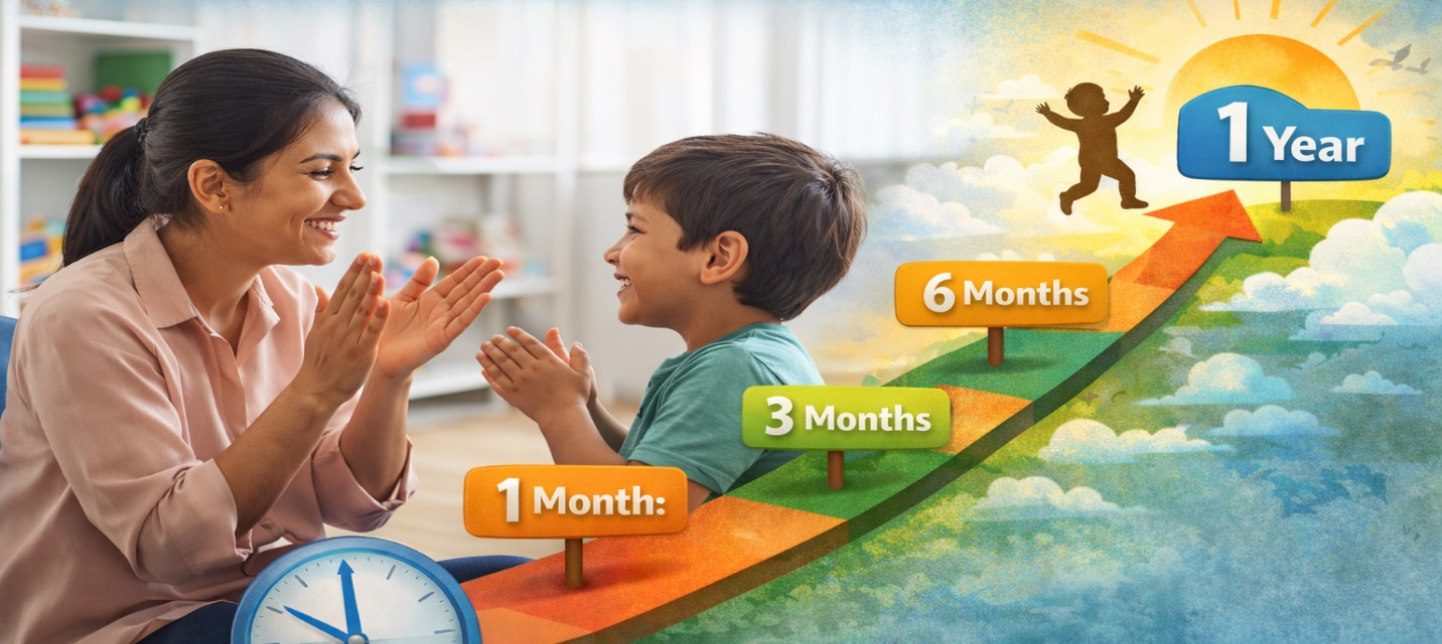
1–3 Months
In the initial months, progress may include:
- Better sitting tolerance
- Reduced minor behavioral outbursts
- Increased response to name
- Improved engagement with therapist
Parents often notice subtle but meaningful changes during this stage.
4–6 Months
At this stage, you may observe:
- Emerging words or gestures
- Reduced frequency of tantrums
- Improved imitation skills
- Better compliance with simple instructions
- Increased attention span
Communication typically begins improving during this period.
6 Months – 1 Year
Significant developments may include:
- Functional communication (requesting needs)
- Better social interaction
- Reduced aggressive or self-injurious behavior
- Increased independence in daily routines
- Improved learning readiness
This stage often brings noticeable transformation.
1–2 Years
Long-term consistent ABA therapy may result in:
- Improved academic skills
- Meaningful conversations
- Stronger peer relationships
- Emotional regulation
- Independence in self-care tasks
For many children, 1–2 years of structured therapy leads to substantial life-changing improvements.
How Do You Know ABA Therapy Is Working?
Parents often worry if therapy is “actually working.”
Here are clear signs of progress:
- Your child responds more consistently
- Challenging behaviors decrease in frequency or intensity
- New words or gestures emerge
- Improved play skills
- Better adaptability to changes
- Increased independence
Progress charts and data tracking also help measure objective improvement.
Remember: progress may not always be dramatic — but consistent small improvements indicate therapy effectiveness.
How Long Does ABA Therapy Generally Last?
ABA therapy duration depends on:
- Child’s goals
- Severity of developmental challenges
- Rate of progress
On average:
- Some children require 1–2 years of therapy
- Others may continue for 3–5 years with reduced intensity
- Some transition to school-based support after foundational skills are built
Therapy intensity often decreases as independence increases.
ABA is not a “quick fix.” It is a structured developmental journey.
How Much Does ABA Therapy Cost in Chennai?
In Chennai, ABA therapy costs vary based on:
- Therapist qualification
- Session duration
- Center reputation
- Individual vs. group therapy
- Assessment charges
On average:
- Per session cost ranges between ₹800 – ₹2,500
- Monthly cost may range from ₹15,000 to ₹60,000 depending on intensity
Intensive therapy programs (20–30 hours/week) cost more due to higher therapist involvement.
Some centers provide:
- Monthly packages
- Parent training support
- Customized therapy plans
It’s important to choose quality and experience over low cost alone.
Why Choose RISE Development Centre for ABA Therapy for Your Child?
Child-Centered Approach
Each therapy plan is tailored to the child’s unique strengths, needs, and learning style.
We focus on:
- Building confidence
- Encouraging independence
- Strength-based learning
Regular Support & Guidance
Parents receive:
- Progress updates
- Counseling support
- Home-program strategies
- Regular review meetings
We believe parent partnership accelerates progress.
Experienced Therapists
Our team consists of:
- Certified ABA therapists
- Special educators
- Behavior analysts
- Child development professionals
Experience matters when designing individualized intervention plans.
Evidence-Based Interventions
We strictly follow:
- Data-driven strategies
- Measurable goals
- Continuous assessment
- Ethical practice guidelines
Our therapy programs are structured, monitored, and outcome-focused.
Final Thoughts
So, how long does it take to see progress with ABA therapy?
The answer depends on the child — but most families begin noticing positive changes within the first few months of consistent therapy.
Meaningful, lasting transformation usually develops over:
- 6 months
- 1 year
- Or 1–2 years of structured support
Patience, consistency, parent involvement, and quality therapy make all the difference.
If you are considering ABA therapy in Chennai and wondering whether your child will benefit — the best first step is a professional assessment.
Early intervention changes lives.
At RISE Development Centre, we are committed to walking this journey with you — one small milestone at a time.
Frequently Asked Questions
How long does it take to see progress with ABA therapy?
Most children begin showing small improvements within 1 to 3 months of consistent ABA therapy. These early signs may include better eye contact, improved attention, or reduced minor behavioral issues. Significant and long-lasting progress typically develops over 6 months to 1 year, depending on the child’s individual needs and therapy intensity.
How long does ABA therapy take to show results?
ABA therapy results vary for every child. Some children respond quickly, while others require more time. Factors such as age, severity of developmental delays, therapy frequency, and parent involvement greatly influence how long ABA therapy takes to show results.
How long does ABA therapy take to work for autism?
For children with Autism Spectrum Disorder (ASD), consistent therapy for 12 to 24 months often leads to noticeable improvements in communication, behavior, and social interaction. Early intervention (before age 5) usually results in faster and stronger outcomes.
Is ABA therapy a lifelong treatment?
No, ABA therapy is not always lifelong. Many children require therapy for 1–3 years, while some may continue with reduced intensity as they grow. As children gain independence and achieve developmental goals, therapy hours are gradually decreased.
How many hours of ABA therapy does a child need per week?
The number of therapy hours depends on the child’s needs:
- Mild developmental concerns: 10–15 hours per week
- Moderate challenges: 20–25 hours per week
- Intensive intervention: 30–40 hours per week
A professional assessment helps determine the appropriate intensity.
What are the early signs that ABA therapy is working?
You may notice:
- Improved eye contact
- Better response to name
- Reduced tantrums or meltdowns
- Increased use of gestures or words
- Improved attention span
- Better participation in daily routines
Small but consistent improvements indicate that therapy is effective.
Can ABA therapy work if my child is older?
Yes. While early intervention provides faster results, ABA therapy benefits children and even adolescents at various ages. The goals may differ, focusing more on social skills, emotional regulation, and independence.
Does parent involvement affect ABA therapy progress?
Absolutely. Parent involvement significantly accelerates progress. When parents practice learned strategies at home and maintain consistency, children generalize skills more effectively across environments.
How much does ABA therapy cost in Chennai?
In Chennai, ABA therapy typically ranges between ₹800 to ₹2,500 per session, depending on therapist qualifications and session duration. Monthly costs vary based on the number of therapy hours required.
How do I know if ABA therapy is right for my child?
If your child experiences delays in communication, social interaction, behavior regulation, or daily living skills, a professional developmental assessment can determine whether ABA therapy is suitable. Early evaluation is the best first step.

Praveena Raveendran
About the Author
Praveena Raveendran is the Founder of RISE Development Centre with over 23 years of experience in speech-language pathology and developmental intervention. A Registered Speech-Language Pathologist (RCI), BASLP, and BCaBA (BACB, USA), she integrates ABA with speech and language therapy to support children with communication, behavioural, and developmental challenges through evidence-based, family-centred approaches.