








ABA Therapy in Chennai
and participate fully in daily life.
What Is ABA Therapy?
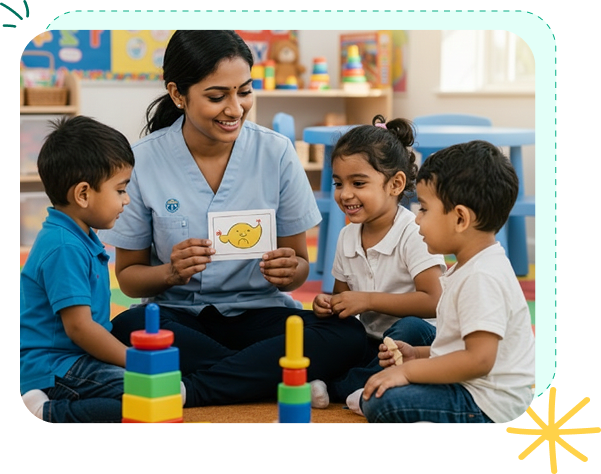
Applied Behavior Analysis (ABA) is a scientifically validated, evidence-based therapy that helps children understand and change behavior through structured learning and positive reinforcement. Rooted in decades of research, ABA breaks complex skills — communication, social interaction, daily routines — into manageable steps, teaching them in a way that is meaningful and lasting.
At Rise Development Centre, ABA goes beyond the textbook. We integrate ABA with speech therapy to create a whole-child approach, addressing not just behaviors but the communication gaps that often drive them. Whether your child is learning to say their first words, navigate a classroom, or manage big emotions, our team is with them — and with you — every step of the way.
Who Needs ABA Therapy?
ABA therapy is most commonly recommended for children with autism spectrum disorder (ASD), but it is also highly effective for children with developmental delays, attention difficulties, language disorders, and behavioral challenges. If your child is struggling to learn, communicate, or participate in daily life in ways that are expected for their age, ABA therapy may be the right fit.
Every child is unique. Our certified therapists conduct comprehensive assessments to determine whether ABA is the right approach and design a program tailored specifically to your child’s needs, strengths, and goals.
When Do You Need an ABA Therapist?
Early intervention makes a profound difference. If you notice any of the following signs in your child, it may be time to consult an ABA therapist:
Delayed Language or
Communication Skills
Your child is not speaking, has fewer words than expected for their age, or struggles to communicate their needs effectively — leading to frustration for both child and caregiver.
Frequent Tantrums or Aggressive Behaviors
Meltdowns, hitting, biting, or other intense behavioral outbursts that occur regularly and are difficult to manage or de-escalate.
Lack of Interest in Social Play
Your child consistently avoids interacting with peers, does not engage in pretend play, or shows little interest in forming connections with other children.
Inability to Complete Daily Self-Care
Difficulty with basic routines such as dressing, brushing teeth, eating independently, or toileting — despite repeated guidance and practice.
Difficulty Following Simple
Instructions
Your child struggles to respond to or carry out basic one- or two-step directions, even in familiar and low-distraction environments.
If you recognize these signs, you are not alone — and early support can make all the difference. Reach out to our team for a comprehensive evaluation.
What We Help With — Our ABA Therapy Services
Communication & Language Development
We build functional communication skills that allow children to express their needs, wants, and feelings effectively. By reducing communication barriers, we reduce the frustration and behavioral challenges that often stem from them — helping children connect with the world around them.
Social Interaction & Peer Relationships
Our therapists teach children how to initiate and maintain conversations, read social cues, take turns, and build genuine friendships. These skills are practiced in structured and natural settings, preparing children for real-world social environments at school and in the community.
Daily Living & Self-Care Skills
Independence starts at home. We work with children on the routines that shape their everyday life — dressing, grooming, mealtimes, hygiene, and more — building confidence and self-sufficiency one step at a time.
Academic & Learning Readiness
From sitting and attending to following classroom routines and completing tasks, we strengthen the foundational skills children need to thrive in educational settings. Our approach supports both the academic and behavioral demands of school life.
Challenging Behaviors & Emotional Regulation
We don’t just manage behaviors — we understand them. Using Functional Behavior Assessments, we identify the root causes of meltdowns, aggression, or self-injury and replace them with healthier, more effective ways to cope and communicate.
Play Skills & Meaningful Engagement
Play is how children learn. We teach children how to engage in purposeful, imaginative, and cooperative play — laying the groundwork for creativity, curiosity, and connection with peers.
Generalization & Real-World Application
Skills learned in therapy only matter if they carry over into real life. We intentionally teach across settings — home, school, and community — to ensure that every skill your child develops becomes a part of how they live and grow.
Our ABA Therapy Treatment Approach
Step 1: Behavior Analysis
We begin by scientifically observing and analyzing your child’s behaviors — understanding what happens before and after each behavior — to build targeted, effective interventions.
Step 2: Individualized Treatment Plans
No two children are the same. Every treatment plan at Rise is built around your child’s unique profile, learning style, goals, and family priorities — not a one-size-fits-all protocol.
Step 3: Data Collection
Progress is measured, not assumed. Our therapists collect detailed data during every session, allowing us to track growth objectively, refine strategies, and celebrate milestones with confidence.
Step 4: Positive Reinforcement
We motivate children by building on what they love. By consistently rewarding desired behaviors and skills, we create a learning environment that is encouraging, engaging, and effective.
Step 5: Functional Behavior Assessment (FBA)
Before addressing any challenging behavior, we conduct a thorough FBA to understand its function — what the child is communicating through the behavior — and develop compassionate, targeted interventions.
Step 6: Prompting & Prompt Fading
We guide children through new skills using structured prompts, then systematically reduce support over time so that children can perform skills independently and with confidence.
Step 7: Discrete Trial Training (DTT)
For skills that require repetition and precision, DTT provides a structured, one-on-one teaching format that breaks skills into small, teachable steps with clear instruction and immediate feedback.
Step 8: Natural Environment Teaching (NET)
Learning happens best in real contexts. NET embeds skill-building into everyday activities and play, making therapy feel natural, motivating, and immediately applicable to daily life.
Step 9: Generalization
Skills are practiced across people, places, and materials to ensure they become truly functional — not just clinic-specific responses.
Step 10: Early Intervention
The earlier we begin, the greater the impact. We prioritize early identification and treatment to capitalize on the brain’s natural plasticity during the critical years of development.
Step 11: Parent & Caregiver Training
Therapy doesn’t end when the session does. We equip parents and caregivers with the strategies, tools, and confidence to support their child’s growth at home and in the community — every single day.
Step 12: Ethical Considerations
Everything we do is guided by the highest ethical standards. We prioritize your child’s dignity, comfort, and well-being at every stage of treatment, ensuring that our methods are not only effective but genuinely respectful of each child as an individual.
ABA Therapy Cost in Chennai
The cost of ABA therapy in Chennai varies depending on the frequency of sessions, the complexity of the child’s needs, and the structure of the program. At Rise Development Centre, we believe that quality therapy should be accessible. We offer transparent, flexible pricing with no hidden fees, and our team is available to walk you through your options and discuss any insurance or funding support that may be available to your family.
Factors to Consider When Choosing the
Best ABA Therapy Center in Chennai

BCaBA Certification
Ensure the center employs Board Certified Assistant Behavior Analysts (BCaBAs) or Board Certified Behavior Analysts (BCBAs) who are trained and credentialed to deliver ABA therapy to the highest professional standards.

Child-Centric Approach
The best ABA centers put your child — not a program — at the center of care. Look for a center that adapts its methods to your child's personality, interests, and learning style.

Individualized Treatment Plans (ITP)
Avoid cookie-cutter programs. Quality ABA therapy begins with a thorough assessment and delivers a treatment plan designed specifically for your child's needs and goals.

Parental Involvement and Training Programs
A center that actively involves parents is a center committed to lasting outcomes. Look for regular training sessions, progress updates, and collaborative goal-setting with your family.

Facility Environment and Safety Standards
The therapy environment should be safe, structured, and sensory-sensitive — designed to support learning without unnecessary stress or distraction.

Location Accessibility and Session Scheduling
Consistency is critical in ABA therapy. Choose a center that offers session times compatible with your schedule and a location that makes regular attendance sustainable.

Cost Transparency and Insurance Support
A trustworthy center will provide clear, upfront information about costs and help you navigate any available insurance, government, or funding options without added stress.

Why Choose Rise Development Centre for
Applied Behavior Therapy?
10+ Years of Collective Clinical Experience
Our team brings over a decade of combined hands-on clinical experience, giving your child access to knowledge, skill, and compassion built through thousands of hours of real-world practice.
Proven Track Record of 100,000+ Successful Sessions
Rise has delivered more than 100,000 therapy sessions — each one a step forward for a child and their family. Our results speak for themselves.
Multidisciplinary Team of Certified Therapists
Our ABA therapists work alongside speech-language pathologists and other specialists to create seamless, integrated care that addresses every dimension of your child’s development.
Individualized, Child-Centered Treatment Programs
Every child who walks through our doors receives a program built specifically for them. We take the time to understand your child deeply before a single goal is set.
Collaborative Parental Support and Guidance
We treat parents as essential partners. Through regular training, open communication, and shared goal-setting, we ensure that your home becomes a powerful extension of your child’s therapy.
Evidence-Based Interventions and Structured Teaching
Everything we do at Rise is grounded in research. Our methods are tested, proven, and continuously refined to reflect the latest advances in behavioral science and child development.
Frequently Asked Questions
What is ABA therapy used for?
ABA therapy is used to help children develop essential communication, social, behavioral, and daily living skills. It is most widely applied for children with autism spectrum disorder but is also effective for children with developmental delays, ADHD, and other learning or behavioral challenges.
How does ABA therapy work?
ABA therapy works by breaking down complex skills into smaller, teachable steps and using positive reinforcement to encourage desired behaviors. Therapists observe, measure, and adjust interventions based on continuous data to ensure each child is making meaningful progress.
Is ABA therapy effective?
Yes. ABA is one of the most extensively researched and evidence-based interventions for children with autism and developmental challenges. Decades of peer-reviewed research support its effectiveness in improving communication, reducing challenging behaviors, and building independence.
Is ABA treatment good for children with Autism?
Absolutely. ABA is widely considered the gold standard intervention for children with Autism Spectrum Disorder (ASD). It is endorsed by leading medical and behavioral health organizations worldwide for its consistent, proven outcomes in supporting children with autism.
Is ABA therapy only for autism?
No. While ABA is most commonly associated with autism, it is a versatile approach that benefits children with a wide range of needs — including developmental delays, language disorders, attention difficulties, and behavioral challenges not related to autism.
Do all autistic children need ABA therapy?
Not necessarily. Every child’s needs are different, and the right intervention depends on the child’s specific challenges, strengths, and goals. A comprehensive assessment by a qualified behavior analyst is the best way to determine whether ABA therapy is appropriate and what form it should take.
How long does ABA therapy last?
The duration of ABA therapy varies depending on the child’s goals, the severity of challenges, and how quickly they progress. Some children benefit from short-term, intensive programs; others may engage in therapy over several years. Our team works with families to set realistic timelines and regularly reviews progress to ensure the plan evolves with your child.