
Every child deserves the opportunity to grow, communicate, and thrive in their own unique way. For children with developmental challenges, Applied Behavior Analysis (ABA) therapy offers a structured and scientifically proven approach to building essential life skills. However, while therapy sessions lay the foundation, true and lasting progress happens beyond the therapy room. It continues at home, where daily interactions reinforce learning.
Parents and caregivers play a crucial role in reinforcing what is learned during therapy. When strategies are consistently practiced in everyday situations, children are more likely to retain skills, generalize behaviors, and gain confidence in real-world environments.
This guide will help you understand how to effectively support your child’s ABA therapy progress at home, making daily life both meaningful and developmental.
Why Do Children Need ABA Therapy?
ABA therapy is widely recognized for its effectiveness in helping children with developmental delays, particularly those with autism spectrum disorder (ASD). It focuses on understanding behavior and using evidence-based techniques to encourage positive changes.
Children benefit from ABA therapy in several ways:
- Improved Communication Skills:Whether verbal or non-verbal, children learn to express their needs more effectively.
- Better Social Interaction:ABA helps children understand social cues, build relationships, and engage with others.
- Reduction in Challenging Behaviors:By identifying triggers, therapy helps replace negative behaviors with positive alternatives.
- Increased Independence:Children learn daily living skills such as dressing, eating, and following routines.
Ultimately, ABA therapy empowers children to navigate their world with greater ease and confidence.
Importance of Family Participation in ABA Therapy
Family involvement is not just helpful. It is essential. Children spend a significant amount of time at home, making it the perfect environment to reinforce learning.
Here’s why parental participation matters:
- Consistency Across Environments:Skills learned in therapy must be practiced in different settings to become permanent.
- Faster Skill Development:Repetition and reinforcement at home accelerate learning.
- Stronger Emotional Connection:Engaging in your child’s progress strengthens trust and bonding.
- Real-Life Application:Home provides natural opportunities to practice skills in everyday situations.
When parents actively participate, therapy becomes a continuous process rather than a limited session.
How Parents Can Support Their Child’s ABA Therapy Progress at Home
1. Understand ABA Principles
Before implementing strategies, it’s important to understand the basics of ABA.
Learning Behavior Basics
ABA is based on the idea that behavior is influenced by what happens before (antecedent) and after (consequence). By identifying these patterns, parents can guide behavior effectively.
Applying Positive Reinforcement
Positive reinforcement is the core of ABA. When a child performs a desired behavior and receives a reward, they are more likely to repeat it. Rewards can be praise, toys, or activities the child enjoys.
2. Practice Skills at Home
Children learn best through repetition and consistency.
Integrating Goals into Daily Routines
Turn everyday moments into learning opportunities:
- Ask your child to request items during mealtime
- Encourage them to follow simple instructions while getting dressed
- Practice social greetings when guests arrive
Encouraging Functional Communication
Support your child in expressing needs clearly. This could include:
- Using words, gestures, or communication devices
- Encouraging eye contact
Prompting simple phrases like “I want” or “Help me”
3. Use Positive Reinforcement
Positive reinforcement helps strengthen behaviors. It encourages children to repeat what they learn.
Recognizing and Encouraging Progress
When a child is acknowledged for doing something right, they feel encouraged. This makes them more likely to repeat that behavior. Even small efforts should be noticed. This includes following instructions or trying a new skill.
Using Meaningful Rewards
Children respond better to rewards they enjoy. These rewards make learning more engaging. Parents can use praise, toys, or extra playtime. This helps reinforce consistent behavior.
4. Create Consistency
Consistency helps children understand expectations. It also makes them feel secure.
Following Familiar Routines
When home routines match therapy practices, children feel less confused. This helps them apply these skills more easily in different settings.
Providing Clear and Predictable Guidance
Simple instructions are easier for children to follow. Consistent responses help them understand what is expected. When all caregivers follow the same approach, learning becomes stronger. It also avoids mixed signals.
5. Model Desired Behaviors
Children learn by watching others. They often copy what they see.
Showing Appropriate Behaviors
Parents can demonstrate actions like greeting others. They can also show sharing and expressing emotions calmly. This gives children clear examples to follow.
Encouraging Imitation as Learning
Children can be prompted to copy simple actions. This helps them practice new skills. Repeating these actions builds confidence and also supports skill development.
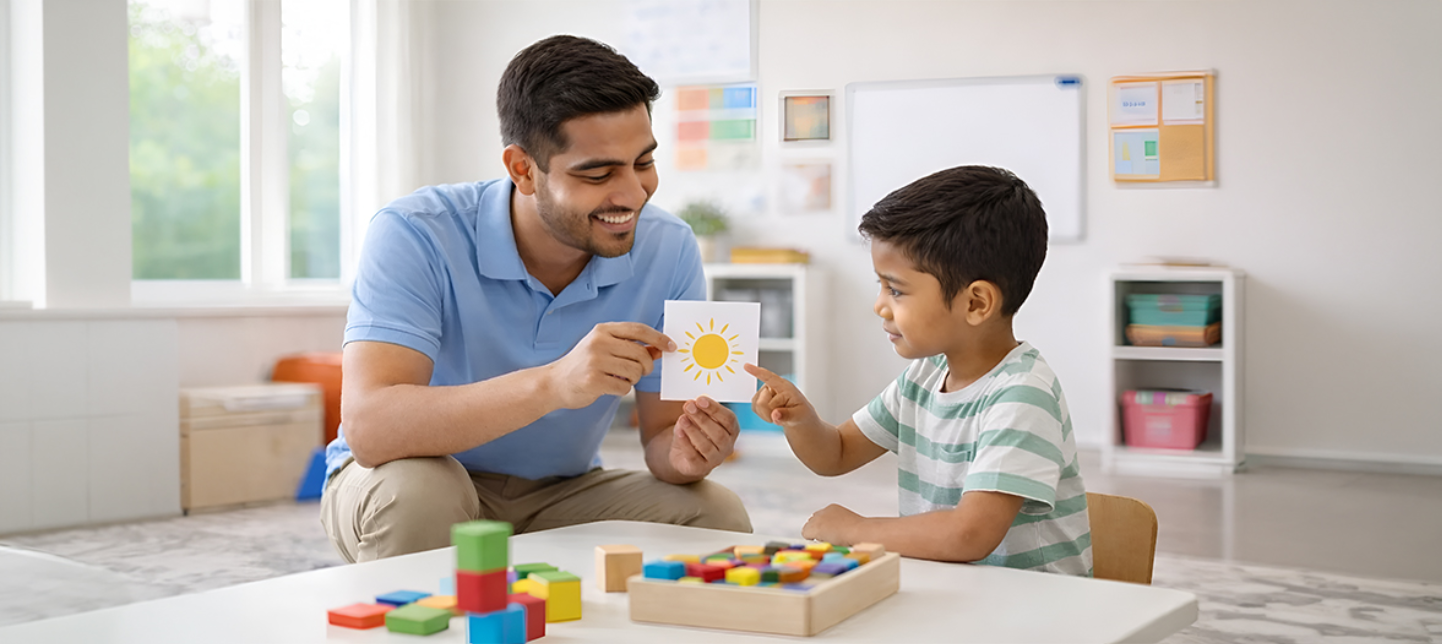
6. Use Visual Supports
Visual tools help children understand better. They make communication clearer.
Simplifying Routines with Visual Aids
Picture charts or schedules show daily activities. This helps children know what to expect. This improves cooperation and also builds independence.
Supporting Transitions with Visual Cues
Visual timers show when an activity will end. This gives children a clear sense of time reducing uncertainty and making transitions smoother.
7. Stay Patient and Flexible
Children learn at their own pace. Progress takes time.
Allowing Time for Learning
Children need time to process information. Giving them time reduces pressure, helps them respond better and also improves understanding.
Adjusting Strategies When Needed
Not all methods work every time. Trying a different approach can help. Flexibility allows parents to find and adapt what works best for the child.
8. Work Closely with the Therapist
Working with therapists improves consistency. It supports better results.
Sharing Observations from Home
Parents can share progress with therapists and discuss their challenges. This helps therapists adjust strategies and ensures better support for the child.
Learning and Applying Techniques
Parents can ask questions and learn therapy methods. This builds confidence in using them at home. Using the same techniques reinforces learning and helps the child progress across settings.
Benefits of Parental ABA Support at Home
When parents actively support ABA therapy, the results can be transformative.
Faster Progress
Consistent reinforcement accelerates skill development.
Practical Real-World Learning
Children learn to apply skills in everyday situations, not just therapy sessions.
Stronger Emotional Bonds
Working together strengthens trust and connection between parent and child.
Greater Confidence and Independence
Children become more confident as they master new skills and gain independence.
Conclusion: Practice at Home, Progress Everywhere
Supporting your child’s ABA therapy at home is one of the most powerful ways to ensure lasting progress. By creating a supportive environment, practicing consistently, and working closely with therapists, parents can make a meaningful difference in their child’s development.
Remember, progress may be gradual, but every small step counts. With patience, dedication, and love, your child can achieve incredible growth.
FAQs
How much time should I spend practicing ABA at home?
Even 20–30 minutes of focused practice daily can make a significant difference. Consistency is more important than duration.
What if my child resists practicing skills?
Start with short, engaging sessions and use rewards to motivate them. Keep activities fun and stress-free.
How do I use visual aids effectively?
Use simple and clear visuals like pictures or charts. Place them where your child can easily see and follow them.
How can siblings help with social development?
Siblings can model behaviors, engage in play, and encourage communication in a natural and supportive way.
What are the most effective rewards for positive behavior?
The best rewards are those your child enjoys—this could be toys, snacks, praise, or favorite activities.
How do I maintain consistency with the therapist’s methods?
Regular communication with the therapist ensures you are following the same strategies at home.
How do I know if progress is happening?
Look for small improvements such as better communication, reduced challenging behaviors, or increased independence.

Praveena Raveendran
About the Author
Praveena Raveendran is the Founder of RISE Development Centre with over 23 years of experience in speech-language pathology and developmental intervention. A Registered Speech-Language Pathologist (RCI), BASLP, and BCaBA (BACB, USA), she integrates ABA with speech and language therapy to support children with communication, behavioural, and developmental challenges through evidence-based, family-centred approaches.